Where every good business decision starts
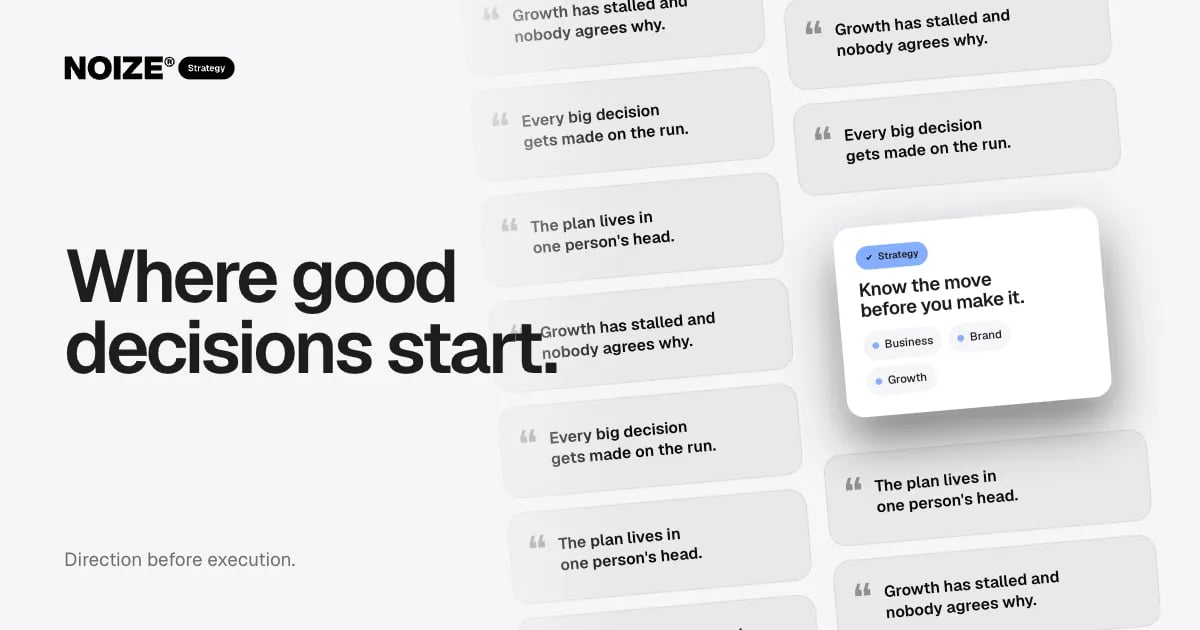
Growth has stalled and nobody agrees why. Every big decision gets made on the run. The plan lives in one person's head.
If any of those sound familiar, the business doesn't have a marketing problem or a hiring problem yet. It has a direction problem. And until that is settled, money spent anywhere else is a bet.
Strategy is the department that settles it. Not with a hundred-page report that sits in a drawer, but with a clear, written answer to the handful of questions every other decision depends on. These are the six we work through with almost every client.
The short version
- Strategy settles the handful of decisions every other department depends on: who the business is for, why customers should choose it, what it sells and at what price, what happens first, how success is measured and who owns each step.
- When those are written down, the brand, the marketing, the sales process and even the funding case get stronger.
- When they aren't, every supplier guesses.
01Who the business is really for
Most businesses can describe their customers. Fewer can say which customers they want more of, and which ones quietly cost them money. A good strategy names the best-fit customer precisely: what they need, where they look, what makes them choose.
That one decision shapes everything downstream. Creative designs for that person. Marketing targets them. Sales qualifies against them. When it is vague, every department guesses, and the guesses don't match.
02Why someone should choose you
In a crowded market, "quality service" and "trusted local experts" describe almost everyone. Positioning finds the thing you do differently that a customer actually cares about, and says it plainly.
This is often the most valuable hour in a strategy engagement. Once a business can say why it wins in one sentence, its website, ads and proposals get shorter and stronger at the same time.
03What you sell, and at what price
Offers tend to grow by accident. A one-off job becomes a service line. A discount becomes the normal price. Strategy looks at what you sell as a whole: which offers to lead with, which to package, which to retire, and whether the pricing matches the position.
Pricing is where strategy pays for itself fastest. A business that is positioned clearly can usually charge more than one that competes on being cheaper.
04What happens first
Every business has more good ideas than money and time. The new website, the second location, the rebrand, the sales hire. All sensible. Done in the wrong order, they cost twice as much.
A growth roadmap puts them in sequence and puts a cost against each step. It shows what to do this quarter, what waits, and what to stop doing. That last part is often the most useful.
> I've worked with multibillion-dollar clients and with founders in their first year, and the best decisions in both looked the same. Someone wrote the next move down before they spent money on it. It sounds obvious. It is surprisingly rare.
05How you will know it is working
A plan needs measures. Not twenty dashboards, but three or four numbers that tell you if the strategy is landing: enquiries from the right customer, conversion rate, average sale, margin.
Agreeing those numbers up front means every department reports against the same goal. It also means you can change course early, instead of finding out at year end.
06Who owns each step
The final decision is the simplest and the most often skipped. Every step on the roadmap gets an owner and a date. Without that, the plan stays in the founder's head, and the founder stays the bottleneck.
How strategy makes every other department better
Strategy isn't a department you visit once. It is the brief every other department works from.
When the direction is agreed, Creative builds a brand around a real position instead of a mood board. Marketing spends on the audience that converts, not the one that clicks. Sales qualifies leads against the best-fit customer. Finance can present lenders with a plan, not a hope. That is why NOIZE Strategy hands off naturally: to Creative when the strategy needs a brand, and to Marketing when it needs an audience.
Every engagement uses the Infin8 System: eight phases and sixty-four steps that look across the whole business. The result is a prioritised, costed roadmap in plain English. Powered by the Infin8 System. Eight phases. Sixty-four steps.
“What I appreciated most was them pushing back when it mattered.”
Signs you need strategy before anything else
A few patterns tell us strategy should come first. The business has tried several marketing agencies and none of them worked. The team describes the business differently depending on who you ask. Big decisions keep getting deferred because nobody is sure which matters most. Or growth was easy for a few years and has now flattened without an obvious reason.
In each case, more execution won't fix it. A clear direction will.
What a strategy engagement looks like
It starts with a conversation about where the business is and where you want it to go. From there we assess the business across all eight Infin8 phases, talk to the people who know it best, look at the customers and the competition, and turn it into a roadmap you can act on the following Monday.
Start with the thinking. Direction before execution.
An illustrative example
Picture a services business in Brisbane that has grown steadily for five years and then stalled. The owner has tried two marketing agencies. Enquiries are up, but sales are flat. The team describes the business three different ways.
A strategy engagement finds that the business has drifted towards smaller jobs that are easy to win and hard to profit from. The best customers, larger commercial clients, have been underserved. The roadmap repositions the business towards them, retires two low-margin offers, raises prices on the rest and sets a new sales process before any new marketing spend.
The marketing didn't change first. The direction did, and then every department had something clear to work from. That is what strategy is for.
Related reading
Common questions
What does a business strategy consultant actually deliver?
At NOIZE, a written, prioritised and costed roadmap: who the business is for, how it is positioned, what it sells, what happens first, how success is measured and who owns each step.
How is brand strategy different from business strategy?
Business strategy decides where the business is going. Brand strategy decides how it presents itself on the way: position, promise, personality and message. We usually do both together.
Is strategy only for large businesses?
No. Founders launching a venture and owner-led businesses facing stalled growth get as much value from it as large leadership teams making a big call.
What happens after the strategy is finished?
You can deliver the roadmap with NOIZE departments, with your own team, or with existing suppliers. The roadmap is yours.
How long does a strategy engagement take?
Most are measured in weeks, not months. The aim is a roadmap you can act on quickly, not a document that takes a quarter to write.
Your first strategy conversation is on us.
Have a chatThe brand for business.