How it fits together: every department in the order a business needs it
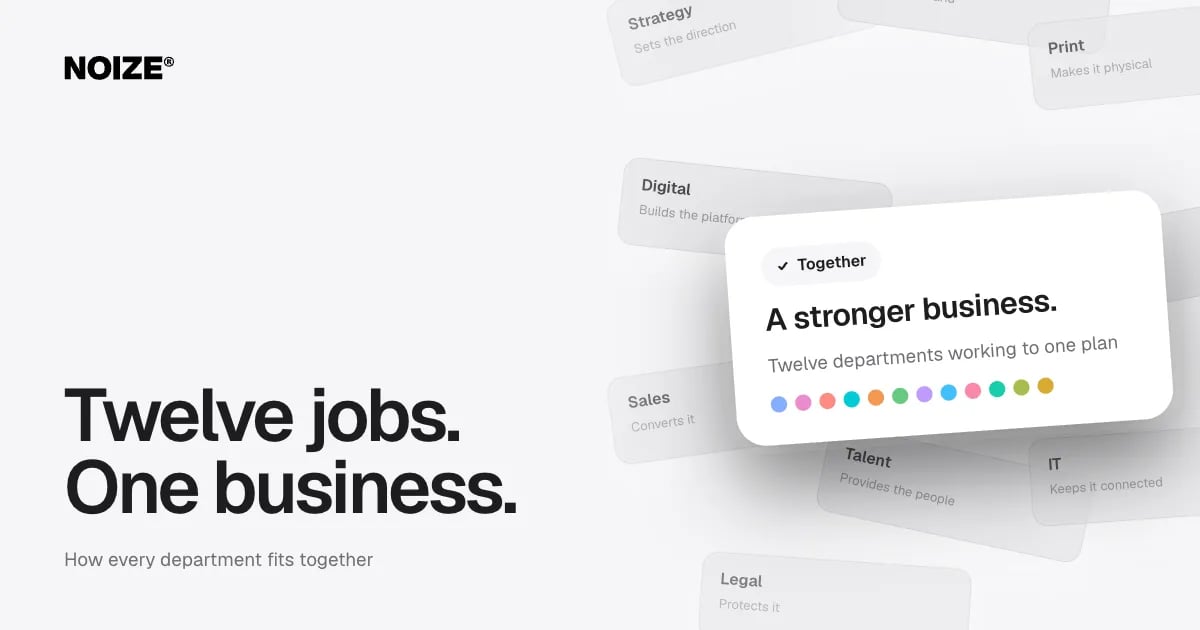
Every business is twelve jobs. Most owners are doing all of them, or paying twelve different people to do them separately.
The jobs aren't random. They connect in a sequence, and each one depends on the one before it. A brand without a strategy is decoration. Marketing without a sales process is expensive noise. Growth without current numbers is a guess.
This guide walks through the multiple departments in the order a business usually needs them, what each one does, and where it hands over to the next. Use it to see where your business is strong, and where the chain is broken.
The short version
- Knowing how to grow a business starts with seeing how its twelve jobs connect.
- A business runs on twelve connected jobs: direction, brand, physical presence, platform, demand, conversion, people, systems, protection, records, interpretation and capital.
- Each one depends on the one before it.
- When they are split across separate suppliers, the owner manages every connection by hand.
- When they sit inside one business group, the hand-offs are planned.
- Use the self-check below to find the link holding the rest back.
Start: set the direction and build the identity
01Strategy sets the direction
Before anything is designed, built or advertised, someone has to decide where the business is going. Who is it for? What does it do better than anyone else? What happens first, and what can wait?
Strategy answers those questions and writes them down. Every other department works from that answer. When it is missing, each supplier invents their own, and the business pulls in twelve directions at once. Read more at strategy.noize.com.au.
02Creative builds the brand
With a clear direction, Creative turns it into something people can see and remember: a name, an identity, a voice, campaigns. A good brand makes the business look like what it is, and makes it hard to mistake for anyone else. See creative.noize.com.au.
03Print makes it physical
The brand has to survive the real world: business cards, signage, packaging, uniforms, vehicles. Print takes approved artwork and makes sure it looks the same on a building as it does on a screen.
Grow: build the platform, create demand, convert it
04Digital builds the platform
The website is the front door, but the business runs on what sits behind it: ecommerce, CRM, integrations and automation. Digital builds the platform around how the business actually operates, so the team stops re-typing data and customers get a smoother path to buy.
05Marketing creates demand
With a brand worth noticing and a platform ready for traffic, Marketing brings the right people in. Paid media, search, social and email, working as one plan instead of five channels, measured from the first click to the final sale.
06Sales converts it
Leads only matter if they become customers. Sales designs the process, the pipeline, the proposals and the follow-up, so more of the opportunities Marketing creates turn into revenue.
> I've taken thousands of sales calls. The pattern I see most is a business that has fixed one link and wonders why nothing changed. Better ads into a broken follow-up just make the leak more expensive. Look at the whole chain first.
Operate: the people, the systems and the protection
07Talent provides the people
Growth needs capability, but not every capability needs a full-time hire. Talent provides fractional, part-time, contract and on-demand people, shaped around what the business needs now.
08IT keeps it connected
Devices, Microsoft 365 or Google Workspace, security, backups. IT keeps the team working and the business protected, and makes sure new starters have a laptop on day one.
09Legal protects it
Agreements with partners, staff, suppliers and customers. Trade marks for the brand Creative built. Legal protects what the rest of the departments create, ideally before anyone needs it.
Evolve: the numbers and the capital
10Books keeps the numbers current
Bookkeeping, payroll and reconciliations, kept up to date weekly, not caught up quarterly. Current books mean every other decision is made on today's numbers.
11Accounting makes sense of them
Tax, statements, forecasts and virtual CFO advice. Accounting turns the records into decisions: can we hire, can we expand, what should we charge?
12Finance funds what comes next
When the plan needs capital, Finance matches the right funding to a clear use of funds. Lenders read the numbers first, which is why it helps that Books and Accounting already have them ready. See finance.noize.com.au.
Why the order matters
Read the list again and the dependencies are obvious. Finance relies on Accounting. Accounting relies on Books. Sales relies on Marketing. Marketing relies on Digital and Creative. Everything relies on Strategy.
When those twelve jobs are split across twelve suppliers, every connection has to be managed by hand, usually by the owner. When they sit inside one business group, the hand-offs are part of the plan.
“Things really got moving beyond our expectations.”
A quick self-check
Run through the chain and answer each question honestly. The first "no" is usually where the work should start.
- Is the direction written down, and does the team agree on it?
- Does the brand look the same on the website, the signage and the proposals?
- Does the website do something useful with every visitor, or does it just sit there?
- Can you say which marketing channel brought in last month's customers?
- Does every lead get a reply within a day, and a follow-up after that?
- Do you have the people you need this quarter, without a hiring process that outlasts the work?
- Does everyone have the access and devices they need, and has the backup ever been tested?
- Are the important agreements signed and the brand trade marked?
- Are the books reconciled this week?
- Do you have a forecast, or just a bank balance?
- If an opportunity appeared tomorrow, could you fund it?
Few businesses answer yes to all of them. That's normal. The value is in seeing which answers are connected, because fixing one link often makes the next easier.
Find the broken link
Most businesses don't need all multiple departments at once. They need to find the link in the chain that is holding the rest back. Sometimes that is the strategy. Often it is the follow-up, the numbers, or a website that looks fine and converts nobody.
Start with one department. Add talent as you need it.
Related reading
- Twelve suppliers or one partner: the hidden cost of running a business by committee
- Start with one: how a single project becomes a business that runs as one
Common questions
Do I need all multiple departments?
No. Most businesses start with one or two. The value of the full set is that the next department is ready when you need it, and already knows your business.
What does start, grow, operate and evolve mean?
They are the four stages NOIZE covers: starting a business or a new venture, growing it, running it well day to day, and changing it as the market moves.
Which department should come first?
Usually Strategy, because every other department works better when the direction is agreed. If something is clearly broken, like overdue books or a website that doesn't convert, we may fix that first.
Can departments be engaged separately?
Yes. Each department can be engaged on its own, or brought together around a larger objective.
What does a business support partner do differently from a single supplier?
A single supplier fixes one link in the chain. A business support partner looks at how the links connect, so fixing one doesn't create a problem in the next.
Your first strategy conversation is on us.
Have a chatThe brand for business.