Protecting what you build, from the first handshake
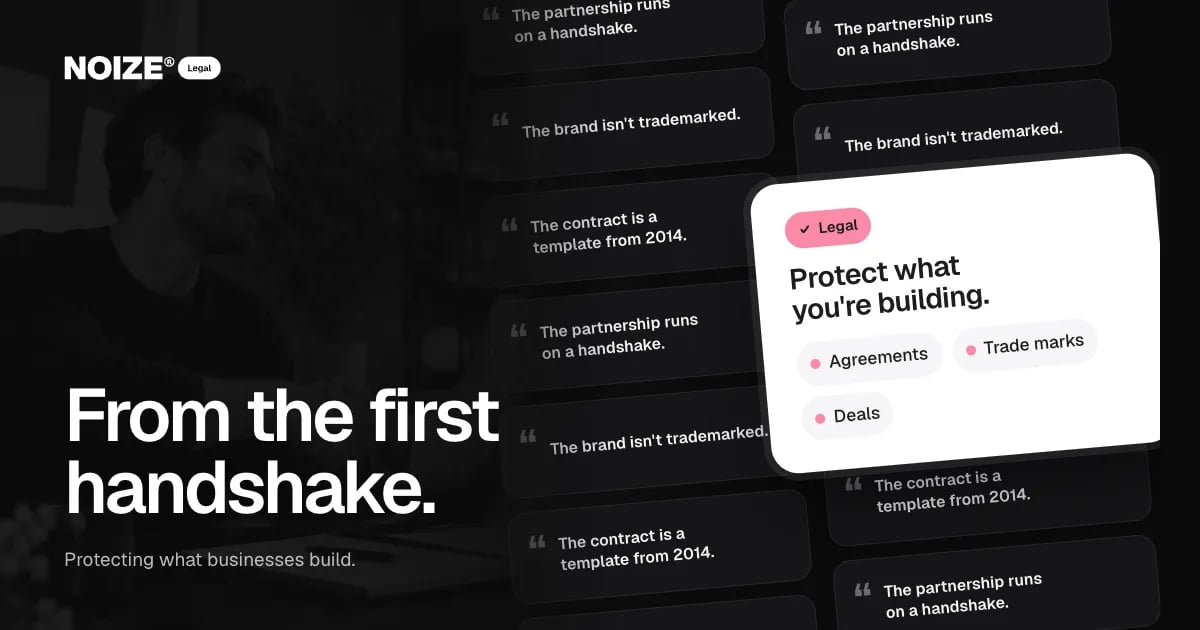
The partnership runs on a handshake. The brand isn't trade marked. The contract is a template from 2014.
Legal work is easy to postpone. While everything is going well, nobody wants to discuss what happens if a partner leaves, a customer doesn't pay or a competitor registers your name. Then something changes, and the conversation happens at the worst possible time, with the least bargaining power.
Every stage of a business has a document that matters. This guide walks through them in order, so you can see what should already be in place and what is coming next. It is written in plain English on purpose. NOIZE provides administrative support and business strategy. Where work is outside our skillset, or the law requires it, we make sure an appropriately qualified professional is involved.
The short version
- Each stage of a business has legal documents that matter, and they are cheapest to get right early.
- Start with structure, an owners' agreement and a registered trade mark.
- Keep terms of trade, privacy and employment contracts current as you grow.
- Treat transactions with extra care, with Finance and Accounting alongside Legal.
- The health check below shows what to tackle first.
Stage 1: Starting out
01Choose the structure deliberately
Sole trader, partnership, company or trust. The choice affects personal liability, tax, how easy it is to bring in investors and how the business can eventually be sold. Many businesses start as whatever was quickest and never revisit it.
Structure is where Legal and Accounting work together. Legal sets it up and documents it. Accounting models the tax. Getting both views at the start avoids an expensive restructure later.
02Put the partnership in writing
If there is more than one owner, a shareholder or partnership agreement settles the questions everyone hopes never to ask: who decides what, how profits are shared, what happens if someone wants out, who owns the brand, and how the business is valued if it changes hands.
Writing it down while everyone agrees protects the business and the relationship.
03Clear and protect the name
Before investing in a brand, check the name can be used and owned: the trade mark, the domain and the social handles. Then register the trade mark. A business name registration generally doesn't give you exclusive rights to the brand. A registered trade mark can.
Stage 2: Trading
04Terms that protect you today
Terms and conditions, service agreements and quote terms should reflect how the business actually trades now: online sales, subscriptions, deposits, cancellations, liability and payment terms. A template from 2014 rarely covers them.
Clear terms speed up payment and reduce disputes, because expectations are set before the work starts.
05A privacy policy that matches reality
Almost every business collects personal information. The privacy policy should describe what you actually collect, why and how it is protected, and the business should be able to back that up. This is where Legal and IT overlap: the policy and the security behind it.
> I've co-founded companies and been through exits, and the documents that mattered most at the end were the ones we wrote at the beginning. A clean shareholder agreement and a registered trade mark made the sale conversations simpler. Missing paperwork is where deals slow down.
Stage 3: Growing
06Employment contracts that fit the role
As the team grows, every person needs a contract that matches their role, their award where one applies, and the business's protections around confidentiality and intellectual property. Contracts found online often miss the parts that matter most.
07Leases and supplier agreements
Premises, equipment and key suppliers usually come with long agreements and significant commitments. Reviewing them before signing is far cheaper than discovering a clause later.
Stage 4: Buying, selling or raising
08Transactions that close on your terms
Buying a business, selling one, or bringing in an investor are some of the biggest contracts an owner will sign. Due diligence, warranties, restraints and settlement all need careful attention, often on a tight timeline.
This is where Legal works with Finance when the deal needs funding, and with Accounting on the structure of the purchase. Running those in parallel is what gets a deal funded, protected and settled on time.
“What I appreciated most was them pushing back when it mattered.”
Why legal belongs inside the business group
Most legal problems start somewhere else. A brand is designed before the name is checked. A partner joins before the agreement is drafted. A funding deal arrives before the structure is right. When Legal sits alongside Creative, Accounting and Finance, those issues are caught when they are cheap to fix.
NOIZE Legal provides commercial legal support designed around the realities of running and growing a business: commercial agreements, shareholder agreements, employment agreements, intellectual property, trade marks, terms and conditions, business structuring, transactions and commercial advice.
Get it in writing. Protecting what businesses build. See legal.noize.com.au.
The cost of leaving it late
Legal work done early is usually quick and affordable. The same issue handled late, during a dispute, a sale or a funding deadline, costs more and gives you less control. A shareholder agreement is a few pages when everyone gets along. Without one, a disagreement can stall a business for months.
The same applies to trade marks. Registering your brand early is simple. Discovering someone else has registered it after you have printed the signage, built the website and run the ads is expensive in every sense. That is why Legal and Creative check names together before anyone falls in love with one.
A simple legal health check
- Is there a written agreement between the owners?
- Is the brand registered as a trade mark?
- Were the terms of trade updated in the last two years?
- Does every employee have a current contract?
- Do you know the key terms of your lease and largest supplier agreement?
- Does the privacy policy describe what you actually do?
Each "no" is a conversation worth having before you need it.
How NOIZE Legal works with you
NOIZE Legal looks after the routine jobs: keeping company registers in order, organising agreements and documents and preparing the information a lawyer needs. You also get practical guidance on protecting what you build, from the first handshake as part of the business strategy.
When something needs a qualified practitioner, an appropriately qualified professional is involved. We agree the arrangement with you before any work begins.
Related reading
- Clear books: the foundation every other decision sits on
- Funding the next move, with the whole plan in view
This article is general information only. It is not legal, tax or financial advice, and it does not take your circumstances into account. Speak to a qualified adviser before acting.
Common questions
When should a business get a shareholder agreement?
As soon as there is more than one owner, ideally before any money or work is contributed.
Is a business name registration the same as a trade mark?
No. A business name registration lets you trade under the name. A registered trade mark gives you exclusive rights to use it as a brand for your goods or services.
How often should terms and conditions be reviewed?
Whenever the way you sell changes, and at least every couple of years.
What should I bring to a legal enquiry?
Tell us what you are signing, protecting or buying, and any documents you already have.
Can NOIZE Legal work with my existing lawyer?
Yes. Some clients keep an existing lawyer for specific matters and use NOIZE Legal for commercial work connected to the rest of the business.
Do I need a lawyer to buy a small business?
It is generally worth considering. Even small business sales involve contracts, leases, staff, stock and goodwill, and the protections you need, such as warranties and restraints, have to be negotiated before you sign. Getting advice early is far cheaper than fixing problems after settlement.
Your first strategy conversation is on us.
Have a chatThe brand for business.