The physical side of a brand, and why it still matters
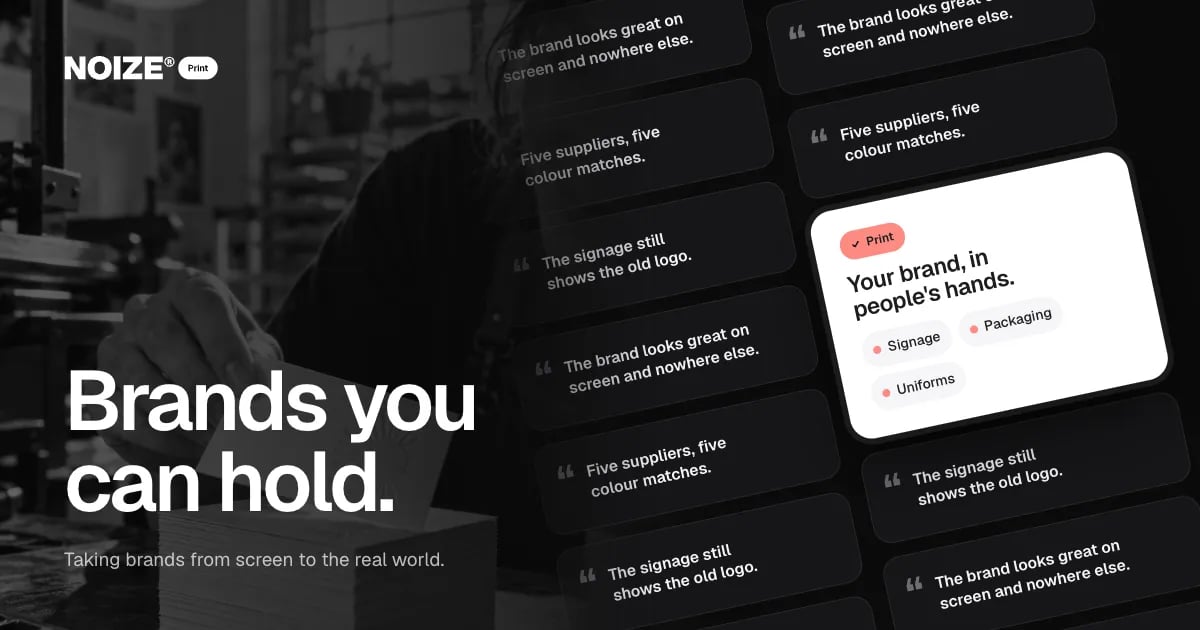
The brand looks great on screen and nowhere else. Five suppliers, five colour matches. The signage still shows the old logo.
It is easy to treat print as an afterthought. Most of the attention, and most of the budget, goes to the website and the ads. Then the business cards come back a slightly different blue, the van wrap is still the old design, and the shopfront tells customers something the website doesn't.
Print is where a brand meets people physically. It is the card handed across a table, the sign someone walks past every morning, the box that arrives at the door. Those moments are fewer than screen impressions, but they are heavier. People hold them, keep them and remember them.
The short version
- Printed pieces are held, kept and remembered in a way screen impressions rarely are.
- Brands most often fall apart in print through colour drift, poor scaling and staggered rollouts.
- One print partner managing every material and every location, working with Creative on artwork and Marketing on measurement, keeps the brand consistent in the real world and makes each piece earn its cost.
Screens are crowded. Hands are not.
A person sees thousands of digital messages a day and scrolls past almost all of them. A printed piece is different. It occupies space. It has weight and texture. It stays on a desk or a fridge or a reception counter long after the ad was skipped.
That is why print still works in 2026, and why the businesses that do it well stand out. A well-made brochure gets passed to a business partner. Packaging that is designed for the opening gets photographed and shared. A shopfront that is clear from across the street turns passing traffic into foot traffic.
None of this replaces digital. It works alongside it. The strongest campaigns use both: the poster that drives people to a landing page, the mail-out with a QR code that gets tracked, the event banner that matches the ads people saw the week before.
Where brands fall apart
Most brands are designed on a screen and approved on a screen. The problems appear when they leave it.
Colour is the most common. The same blue looks different on coated card, uncoated stock, fabric, vinyl and acrylic. Across five suppliers, each with their own process, the result is five blues. Customers may not name the problem, but they notice something is off.
Scale is next. A logo with fine detail looks elegant at business card size and turns to mush on a building. A tagline that reads well on a website is illegible on a van at 60 kilometres an hour.
Then there is timing. A rebrand launches on the website overnight, but the signage takes six weeks, the uniforms take eight and nobody ordered new cards. For two months the business looks half old and half new, which is worse than either.
> I've watched businesses spend a fortune on a new brand and then roll it out one supplier at a time. The website was new, the van was old, the invoices were somewhere in between. Customers don't see the effort. They see the inconsistency.
What good print management looks like
Good print starts before anything is printed. The artwork is designed with the real world in mind: tested at the smallest and largest sizes, set up with the right colour profiles for each material, and checked for legibility at distance.
Then one team manages production across everything: cards, stationery, brochures, signage, packaging, labels, merchandise, uniforms, vehicle graphics, event collateral and large-format printing. One colour standard is applied to every stock and every site. Proofs are approved once. Reorders come from the same files, so the hundredth box of cards matches the first.
For multi-site businesses this matters even more. A franchise or a group with locations in Brisbane, Sydney and Melbourne should look like one business in all three. With separate local printers it rarely does. With one print partner managing every location, it can.
“Exceeded our expectations in terms of quality, design and timeframe.”
Print as part of the whole business
Print doesn't work in isolation, which is why it sits inside the NOIZE group instead of beside it.
When the artwork needs designing or refreshing, Creative does it with the print outcome in mind. When a launch needs an audience, Marketing connects the physical pieces to a measurable campaign, so a flyer drop or a mail-out can be tracked through to enquiries and sales. When a rebrand rolls out, Print plans the inventory, priorities and dates alongside the website launch, so everything changes on the same day.
That is the difference between buying print and having a print department. A printer reproduces what you send. A print department makes sure what you send is right, and that it matches everything else your customers see.
Where print earns its place today
Not everything needs to be printed. The pieces that earn their place are the ones that do a job digital can't.
Signage that tells people where you are and what you do. Packaging that makes the first physical moment of a product feel considered. Business cards and stationery that match the price point of the service. Uniforms that make the team recognisable. Vehicle graphics that turn every trip into an impression. Brochures and guides that people take home and pass on. Event collateral that makes a stand look like a brand instead of a table.
Each one is a one-off cost that works every day for years. Done well, they are some of the most efficient marketing a business can buy.
A print checklist before you order
- Is the artwork final and approved by the person who owns the brand?
- Is it set up for the material it will be printed on?
- Has a proof been checked for colour, spelling and contact details?
- Are the quantities right for the next six to twelve months, not just this week?
- And does the piece have a clear job, with a next step for the person holding it?
Before anything goes to press, check five things.
Those five checks prevent most reprints. They also make sure every printed piece earns the money it costs.
Related reading
Common questions
Is print still worth it for a digital-first business?
Usually, yes. Packaging, signage, cards and event collateral are moments a screen can't replace. The key is linking them to digital, so they can be measured.
Why do my printed colours never match?
Different materials and printing processes reproduce colour differently. A single print partner working from one colour standard, with proofs for each material, solves most of it.
Can you manage print across multiple locations?
Yes. Print management across sites is one of the main reasons businesses use a single print department.
What do I need to send for a print quote?
The artwork, the quantities and the date you need it by. If the artwork needs designing, Creative can help.
Can print be tracked like digital marketing?
Yes. QR codes, unique offer codes, tracked phone numbers and dedicated landing pages let you measure responses from printed pieces.
Your first strategy conversation is on us.
Have a chatThe brand for business.