The gap between a lead and a customer
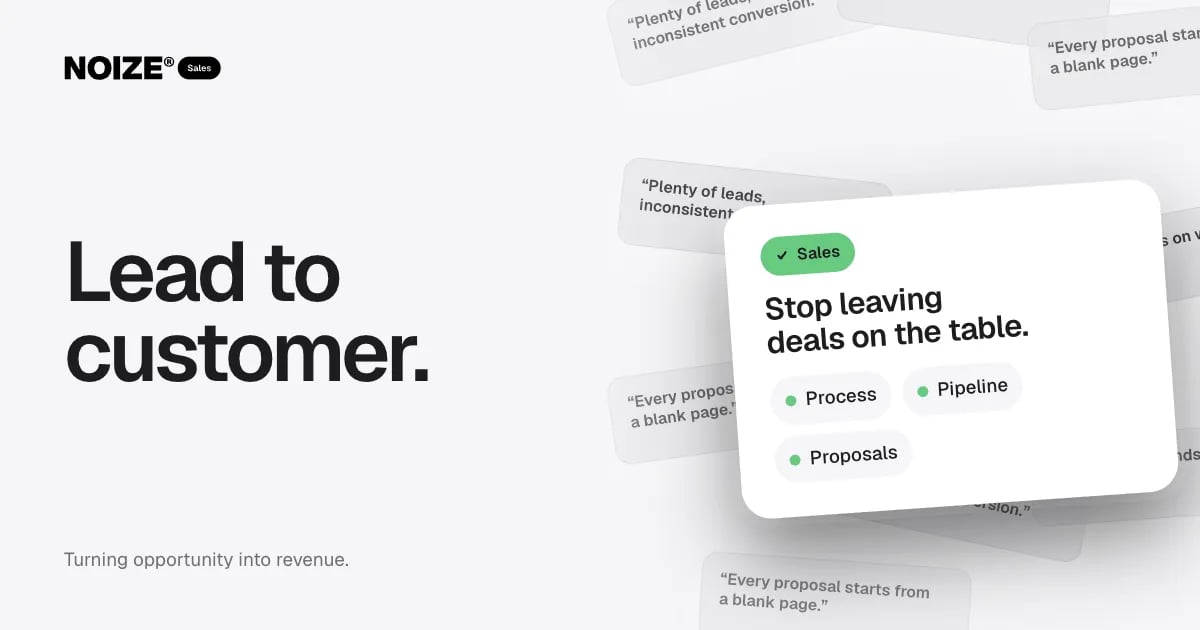
Plenty of leads, inconsistent conversion. Follow-up depends on who remembers. Every proposal starts from a blank page.
Every business has a gap between the moment someone shows interest and the moment they pay. Some of that gap is natural: people compare, think and talk to their partner. Much of it is self-inflicted. Slow replies, vague proposals and follow-up that stops after one email lose deals that were already half won.
This guide walks through closing that gap, step by step, the way NOIZE Sales approaches it.
The short version
Most businesses lose deals in the gap between interest and payment, usually through slow replies, vague proposals and follow-up that stops too early. Closing that gap means finding where deals are lost, defining a qualified lead, replying fast, running a pipeline, using proposal templates, following up on a rhythm and documenting the process so it doesn't depend on the founder.
Step 1: Find where deals are lost
- Did they never get a reply?
- Did the quote take a week?
- Did they go quiet after the proposal?
- Did they choose someone cheaper, or someone clearer?
Start with the last ten deals you didn't win. For each one, write down where it stopped.
Patterns appear quickly. Most businesses lose the majority of deals at one or two points, and fixing those is far cheaper than buying more leads.
Step 2: Define a qualified lead
Not every enquiry deserves the same effort. Agree, in writing, what a good-fit lead looks like: the type of customer, the size of the job, the timeframe, the budget signals.
This definition is shared with Marketing, so campaigns are judged on qualified leads, not raw enquiries. It also protects the sales team's time for the opportunities most likely to close.
Step 3: Reply fast
Speed is the cheapest conversion lever there is. A lead contacted within the hour is far more likely to become a conversation than one contacted the next day, simply because they are still thinking about the problem.
Set a target response time and make it visible. Route enquiries automatically to whoever is responsible. If nobody is available, send an immediate, useful acknowledgement with a time for the call back.
Step 4: Build the pipeline
A pipeline turns a pile of enquiries into a set of stages: new, contacted, qualified, proposal sent, negotiating, won, lost. Each deal sits in one stage, with a value and a next action.
The point isn't the software. It is the habit. When every deal has a stage and a next step, nothing is forgotten, and the business can see next month's revenue before it arrives.
> I've taken thousands of sales calls, and the deals I lost early on were rarely lost on price. They were lost to silence. I'd send a quote, feel good about it and wait. The customer was waiting too, for someone to make the next move.
Step 5: Stop writing proposals from scratch
A winning proposal contains four things: their problem in their words, your plan, clear pricing and one next step. It doesn't need to be long. It needs to be specific and look like the brand.
Templates, pitch decks and approval flows mean proposals go out the same day, look consistent and take minutes rather than hours. That speed is itself a competitive advantage.
Step 6: Follow up on a rhythm
Most deals need several touches before they close. Most businesses stop at one. A follow-up rhythm sets out what happens on which day after a proposal: a check-in email, a short call, a relevant case study, a final nudge.
Much of it can be automated, which is where Digital connects the CRM to email and SMS. The personal touches stay personal. The reminders stop depending on memory.
Step 7: Get it out of the founder's head
In many businesses the founder is the sales process. They take the calls, write the quotes and close the deals. It works until the business needs to grow past one calendar.
Documenting what works, the questions, the objections, the pricing logic and the close, turns it into a playbook someone else can run. Then Talent can bring in the right people, fractional, part-time or full-time, to run it.
Step 8: Measure and improve
Track a few numbers every month: response time, conversion from lead to proposal, conversion from proposal to win, average deal size and time to close. Each one points to a specific fix. Together they show whether the gap is closing.
“Couldn't recommend these guys enough.”
How Sales fits with the other departments
Sales sits between demand and delivery. Marketing brings the leads. Sales converts them. Talent provides the people to run the process. Digital builds the CRM and automation behind it. When those four work from one plan, the gap between a lead and a customer gets measurably smaller.
Close more of what you start. Turning opportunity into revenue. See sales.noize.com.au.
An illustrative before and after
Imagine a trade business on the Gold Coast receiving plenty of quote requests. Before: enquiries arrive by email and phone, the owner replies when he can, quotes are written from scratch at night, and follow-up happens if he remembers. After: every enquiry creates a CRM record, gets an acknowledgement within minutes and a call within the hour. Quotes come from templates in the same afternoon. A three-step follow-up runs automatically.
Nothing about the leads changed. The business simply stopped losing the ones it already had. That is usually the fastest growth available.
What a sales review looks at
When NOIZE Sales reviews a process, we look at the pipeline, the proposals and the follow-up, and show you where deals are lost. We bring the findings back as a short list of fixes in order of value, so the first changes are the ones that pay back fastest.
Related reading
Common questions
What does a sales consultant actually do?
At NOIZE, we review your pipeline, proposals and follow-up, show you where deals are lost, then design and build the process, templates and systems to fix it.
Do I need a CRM to improve sales?
A simple pipeline can start on a spreadsheet, but once more than one person sells, a CRM set up around your process makes the biggest difference.
Can you provide salespeople as well as a process?
Yes. NOIZE Talent can provide fractional, part-time or outsourced sales capability once the process is in place.
How quickly can conversion improve?
Fixes like response time and follow-up rhythm often show results within weeks. Process and team changes take longer to settle.
What should I bring to a sales review?
Access to wherever your leads and deals are tracked, a few recent proposals, and your best guess at where deals are lost. We'll take it from there.
How do I stop leads going cold?
Reply quickly, ideally within the hour, and set a follow-up rhythm so every lead gets several useful touches after the first contact. Automate the reminders and keep the conversations personal. Most leads that go cold were never followed up properly.
Your first strategy conversation is on us.
Have a chatThe brand for business.