How to write a brand positioning statement that works
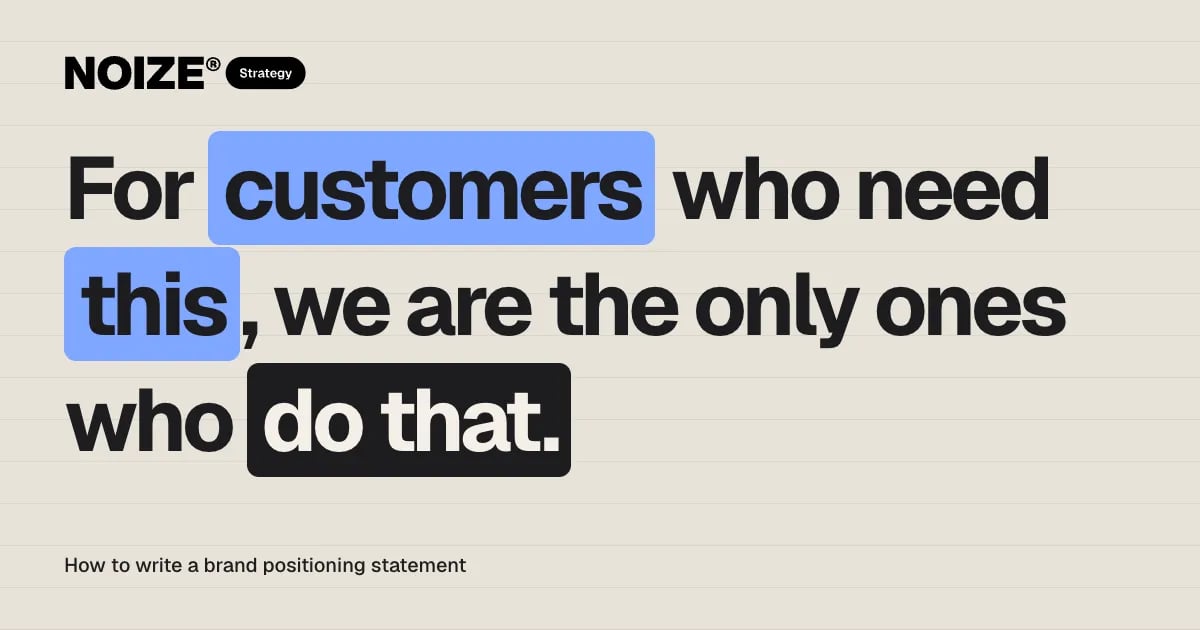
A positioning statement is the foundation of a brand. It says who the business is for, what it does for them and why it is different. Your messaging, design and marketing all grow out of it.
Most positioning statements don't work. They are full of words like "innovative", "passionate" and "customer-focused". They could describe any business in any industry, so they say nothing.
This guide shows you how to write one that works, in four parts, with a simple test at the end.
The short version
A brand positioning statement answers three questions: who is it for, what does it do for them, and why is it different? Use this formula: For [target customer], [your brand] is the [category] that [key benefit] because [reason to believe]. Be specific about the customer, choose a category you can lead, pick one benefit and back it with proof. A good statement makes some people say "that's exactly what I need" and others say "that's not for me".
The formula
Every strong positioning statement fits this shape:
For [target customer], [your brand] is the [category] that [key benefit] because [reason to believe].
Each part does one job. Fill them in one at a time.
01The target customer
Be specific. Not "small business owners". Try something like "service business owners with five to twenty staff who have outgrown doing everything themselves".
It feels risky to narrow it down. In practice, a specific statement attracts more of the right people than a broad one, because people want to feel something was made for them.
02The category
Name the category you want to lead, not just the one you are in. This is where most businesses undersell themselves.
"A marketing agency" has thousands of competitors. "The marketing team for healthcare clinics" is a category you could own.
03The key benefit
Pick one benefit. Not three, and not five.
It is tempting to list everything you do well. Don't. People can't hold several claims in their head at once. Choose the one that matters most to your customer and own it.
04The reason to believe
This is the proof. Why should anyone believe your claim? It could be a qualification, a process, a track record or a method nobody else uses. Whatever it is, it has to be specific and checkable.
How to test it
Read it out loud. Does it sound like a person talking, or like a committee wrote it? If it sounds like a committee, rewrite it.
Then show it to a few customers. A good statement makes some people say "that's exactly what I've been looking for" and others say "that's not for me". If everyone says "sounds good", it is probably too broad.
The best statements feel almost uncomfortably direct. They name the customer, the problem and the answer in plain words. That directness is what makes them work.
Where it goes next
The positioning statement usually stays an internal tool. Customers rarely see it word for word. Instead it shapes your headline, your website, your sales pitch and the way your brand looks. It sits at the centre of a full brand system, which we explain in What is Branding DNA.
“What I appreciated most was them pushing back when it mattered.”
Start with one
If you have tried to write your positioning and it keeps coming out vague, an outside view helps. NOIZE Strategy works it out with you. Then NOIZE Creative turns it into a brand people recognise.
Common questions
What is the difference between positioning and a tagline?
Positioning is the internal decision about who you are for and why you are different. A tagline is one short public line that might come out of it.
How long should a positioning statement be?
One or two sentences. If it needs a paragraph, it is trying to do too much.
Can a small business have a positioning statement?
Yes, and it often matters more. A clear position helps a small business stand out against bigger competitors with bigger budgets.
How often should I update it?
Review it when your customer, offer or market changes in a meaningful way. Otherwise, leave it alone. Consistency is part of what makes it work.
Your first strategy conversation is on us.
Have a chatThe brand for business.